
Vision
Vision
A world where the oceans around us is full of life, bringing joy,
vitality and hope for a bright future to everyone connected to the sea
Seafood Legacy envisions a world where the oceans around us is full of life, bringing joy, vitality and hope for a bright future to everyone connected to the sea.
However, as our work till now has repeatedly shown, fishing regulations alone will not be enough to restore the true abundance born from harmony between marine ecosystems, economy and society.
For regulatory systems to be effective enough to deliver tangible benefits to society, these legal regulations must be aligned with the powerful driving force that is market demand. Only when working in sync can these two gears propel the sustainable transformation of the seafood industry.
That is why our focus is on market transformation, a process that shifts the purchasing power of the market into an impetus for structural reform within the seafood value chain.
Since its founding in 2015, Seafood Legacy has launched and led a movement to advance sustainability in the seafood industry of Japan, one of the world’s leading seafood markets. Building upon these achievements, we are now expanding our scope beyond Japan to the whole of Asia, leveraging our global network and deep expertise to foster collaborations across the boundaries of businesses, financial institutions, policymakers and civil society organizations.
Our goal is to turn the responsible practices of individual companies into industry-wide standards, and transform pioneering initiatives in individual countries into a shared infrastructure across Asia. In an era of geopolitical risks and volatile social conditions, this commitment is more important than ever. Driven by the shared values of our stakeholders, we remain dedicated to ensuring that the legacy of our abundant oceans reaches future generations.
Mission
Building a responsible seafood economy for future generations
We aim to create an economy where honest producers and businesses committed to stewardship of the oceans are properly recognized and valued, and where sustainable choices lead directly to economic success.
2030 Milestone
Making “S.E.A.FOOD” the mainstream
In a market environment where sustainable seafood is the obvious choice for consumers, with no need to worry about environmental or social issues, honest producers and businesses are shielded from exploitative price competition. This helps ensure that future generations inherit the bounty of the sea, the pride of our industry, and a thriving society.
Theory of change
The shift to accountability
All Seafood Legacy activities are based on our Theory of Change, which outlines the path to achieving our 2030 Milestone. Market transformation lies at the very core of this, strengthening accountability and fundamentally transforming the structure of the seafood industry.
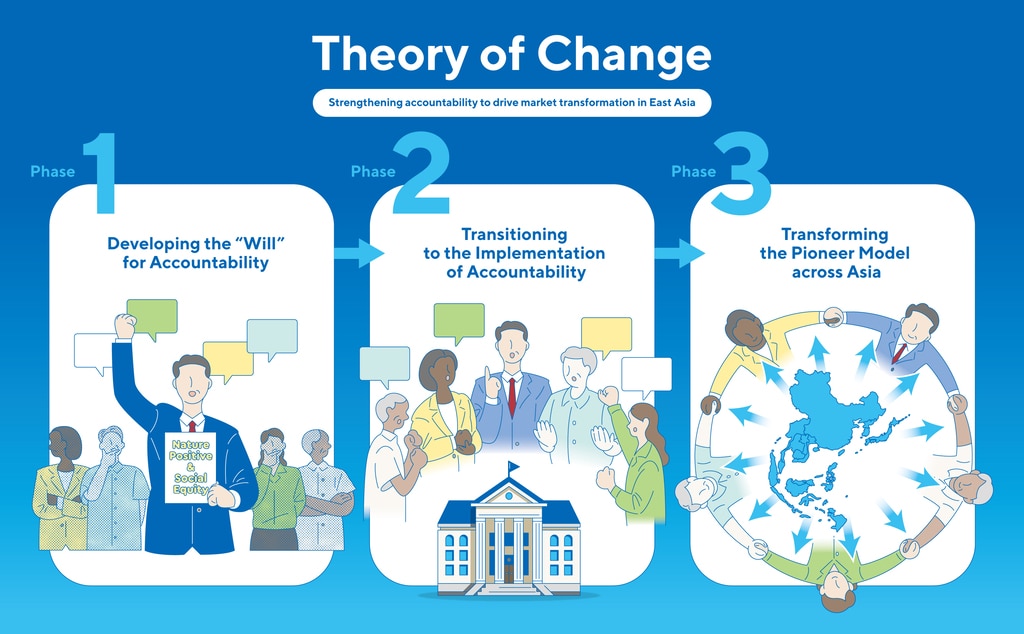
Phase 1: Developing the “Will” for Accountability
The first stage of this change approaches with creating an environment for pioneering companies to voluntarily demonstrate accountability.
Japan was once renowned as the world’s largest fishing nation, and was home to the third-largest import market where seafood from around the globe could be found. Yet this appetite for seafood eventually led to intense international criticism of the country for its excessive fishing, discounting and consumption, habits said to be driving the destruction of marine ecosystems.
However, after the launch of the SDGs and repeated hosting of large international events in Japan, major Japanese seafood companies began voluntarily incorporating responsible procurement into their business strategies. The rise of ESG investment and financing has now made this company's voluntary commitment to accountability a rational economic decision.
Amid these developments, pioneering companies have come together under collaborative platforms such as the Japan Responsible Seafood Roundtable (JRSR). A new approach to business is emerging in which companies take the lead in demonstrating accountability to the market, establishing joint policies and enhancing supply chain transparency to solve structural challenges that would be difficult for individual entities to overcome alone.
Phase 1 Seafood Legacy projects:
- Japan Financial Leverage
Phase 2: The “Institutionalization” and Implementation of Accountability
先駆的な企業が自発的に説明責任を果たす取り組みが進むにつれ、変革は第二段階へと進みます。
With these pioneering companies moving forward in demonstrating accountability, the change moves into its second phase.
A movement relying solely on voluntary efforts would encounter barriers, such as unfair competitive environments and declining effectiveness. To overcome these, pioneering companies make recommendations to the government to establish their voluntary responsible procurement and accountability standards as industry-wide norms. This is a decisive turning point that elevates accountability from a voluntary effort to a true societal framework.
The key here is for companies with significant environmental, economic and social impact to speak with one unified voice.
For instance, in 2024, 13 major seafood companies in Japan submitted a joint petition (in Japanese) calling for the expansion of species covered by the Act on Ensuring the Proper Domestic Distribution and Importation of Specified Aquatic Animals and Plants (Fishery Products Distribution Act), which aims to combat illegal, unreported, and unregulated (IUU) fishing by leveraging the international purchasing power of the Japanese market. The CEOs of the industry’s two largest companies also made a joint public appeal for enhanced traceability. A movement like this reflects the strong momentum from the private sector, which has brought about a significant shift in the Japanese government’s previously cautious stance.
In the quest for accountability, we will continue amplifying the voices of pioneering companies to help drive the transformation of social systems.
Phase 2 Seafood Legacy projects:
Phase 3: Transforming the Pioneer Model into a Foundation for Asia-Scale Development
In the third phase of the change, these companies’ pioneering actions will, at last, become requirements across the entire Asian market.
To ensure the transition to a society where all businesses can demonstrate accountability, it is essential to have orchestrators that can harmonize the actions of businesses, financial institutions, policymakers and civil society organizations, and direct them toward a single overarching goal. This is a key element of the third phase in our Theory of Change.
As one of such orchestrators, we hold the Sustainable Seafood Summit (TSSS), one of Asia’s largest events dedicated to seafood sustainability, and operate Seafood Legacy Times, Japan’s first media outlet specializing in seafood industry sustainability. These platforms have served as hubs that build resonance among a range of emerging initiatives to advance consensus within the seafood industry.
Across Asia, civil society organizations (CSOs) with an understanding of the dynamics behind policymaking and socioeconomic implementation are rapidly building collaborative frameworks to tackle environmental and social issues. It is precisely in these times of global uncertainty that we must keep advancing transformation without missing a beat, using our resonance with stakeholders as a driving force to ensure that the legacy of our abundant oceans reaches future generations.
Phase 2 Seafood Legacy projects:
- S.E.A.FOOD Platform Design Lab
- Leading CSO Collaboration across Asia
Credo
01.Responsibility to future generations
02. Responsibility to our partners
03.Responsibility to our employees
ABOUT US
MESSAGE
MEMBER



© Seafood Legacy Co., Ltd. All rights reserved.